

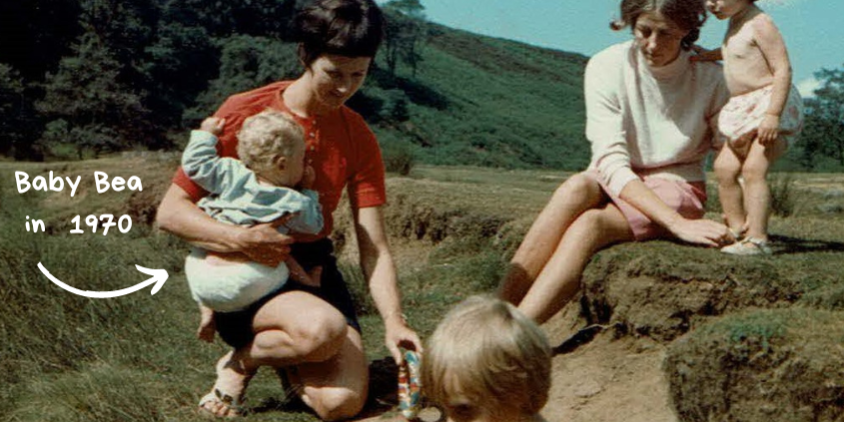
This article was written for Baby College by Nina Politimou, Senior Teaching Fellow at UCL, Institute of Education and an Associate Lecturer at Birkbeck, Department of Psychological Sciences and yes that is our Baby College CEO, Bea, enjoying a 1970s childhood with lots of immune boosting outdoor play!
1. Sun exposure. Sun exposure is important for our bodies as it helps them produce vitamin D, a vitamin that plays a significant role in supporting immunity in babies and children. Sun exposure also promotes healthy sleep and, in turn, our mood. For babies and children, studies across different countries show that being exposed to outdoor fresh air and sunshine during the day helps them regulate their sleep-wake patterns and thus, sleep better at night! [1,2,3]
2. Developing motor skills. Children need the opportunity to use their whole body to develop their gross and fine motor skills. Outdoor spaces create these opportunities and outdoor play encourages activities such as ball games, riding a bike and climbing, all important for whole body and hand to eye coordination. For babies, playing outdoors in a park or garden encourages them to move and crawl further to reach new objects. Fine motor skills are also developed as babies and toddlers like to pick up natural treasures like leaves and rocks. (Meeting Milestones Article)
3. Boosting learning and developing executive functions. Babies and young children learn and accumulate experience using all their senses. The variety of the outdoor space offers an incredibly stimulating and multi-sensory experience, an ideal place to support learning. Executive functions are the cornerstone of effective learning; they are very important skills that help us plan, prioritize, problem-solve, multitask and be creative. Being outside allows children to practice these important skills through unstructured playtime, which provides them with opportunities to make up their own games, explore, entertain themselves and discover their boundaries. Contrary to what was the traditional view that wanted children to spend lots of their time in learning situations that are directed by adults, research has recently started to show the benefits of unstructured play for boosting active problem-solving and in turn executive function [4].
4. Risk taking. Although watching children taking risks can sometimes be stressful for parents, it is important for children to explore by themselves what they can and cannot do. In risk taking the child needs to recognise a challenge, evaluate it and make decisions about what to do [5]. Outdoor spaces are ideal for bringing children in such situations and research has shown that exposure to risky play and access to outdoor spaces can improve competence, boost young children’s self-esteem and independence and teach them how to deal better with conflict [6,7]. Eventually, it can be reassuring for parents to know that their child knows how to protect themselves! (Resilience Article)
5. Boosting immunity. Recent work has shown that reasonable exposure to dirt and microbes in early childhood can actually boost children’s immune systems. Exposure to diverse bacteria that are prevalent in dirt and contact with animals can establish a stronger, more robust immune system and can prevent allergies. Furthermore, bacteria present in the surface of the skin can actually help fight inflammation when children get hurt [8,9].
6. Reducing sedentary lifestyle and increasing physical activity. Outdoor play can increase opportunities for physical activity. It helps children develop a positive attitude towards exercise while reducing opportunities for sedentary behaviours such as using electronic devices and watching TV. According to the World Health Organisation, it is important for children to stay active for at least an hour per. Physical activity when coupled with reducing sedentary behaviours has multiple health benefits ranging from improved health of the cardiometabolic system to supporting prosocial behaviour and boosting academic performance [10].
7. Appreciating the natural environment. Playing outdoors is a great way to explore and enjoy nature and learn to appreciate the environment. Children get opportunities to expand their imagination through using natural materials for pretend play, to observe animals, climb trees and play with water. Children who spend time enjoying nature, even within their neighbourhoods, are more likely to appreciate the value of the natural world and become environmentally aware as adults [11].
8. Developing social skills. It is important for children to learn to approach people and to cultivate their social skills. In order to build good quality friendships, which are so important for healthy social development [12[, they need to learn to share and collaborate with other children. The unstructured setting of outdoor play brings children together and offers plenty of opportunities to interact, regulate their play and develop social understandings from an early age.
References/Further reading
[1] LeGates, T. A., Fernandez, D. C., & Hattar, S. (2014). Light as a central modulator of circadian rhythms, sleep and affect. Nature Reviews Neuroscience, 15(7), 443-454.
[2] Baradaran Mahdavi, S., Mansourian, M., Shams, E., Qorbani, M., Heshmat, R., Motlagh, M. E., … & Kelishadi, R. (2020). Association of Sunlight Exposure with Sleep Hours in Iranian Children and Adolescents: The CASPIAN-V Study. Journal of tropical pediatrics, 66(1), 4-14.
[3] Nakade, M., Takeuchi, H., Taniwaki, N., Noji, T., & Harada, T. (2009). An integrated effect of protein intake at breakfast and morning exposure to sunlight on the circadian typology in Japanese infants aged 2–6 years. Journal of Physiological Anthropology, 28(5), 239-245.
[4] Barker, J. E., Semenov, A. D., Michaelson, L., Provan, L. S., Snyder, H. R., & Munakata, Y. (2014). Less-structured time in children’s daily lives predicts self-directed executive functioning. Frontiers in psychology, 593.
[5] Brussoni, M., Gibbons, R., Gray, C., Ishikawa, T., Sandseter, E. B. H., Bienenstock, A., … & Pickett, W. (2015). What is the relationship between risky outdoor play and health in children? A systematic review. International Journal of Environmental Research and Public Health, 12(6), 6423-6454.
[6] Lavrysen, A., Bertrands, E., Leyssen, L., Smets, L., Vanderspikken, A., & De Graef, P. (2017). Risky-play at school. Facilitating risk perception and competence in young children. European Early Childhood Education Research Journal, 25(1), 89-105.
[7] Hüttenmoser, M. (1995). Children and their living surroundings: Empirical investigations into the significance of living surroundings for the everyday life and development of children. Children’s Environments, 403-413.
[8] Roslund, M. I., Puhakka, R., Grönroos, M., Nurminen, N., Oikarinen, S., Gazali, A. M., … & ADELE Research Group. (2020). Biodiversity intervention enhances immune regulation and health-associated commensal microbiota among daycare children. Science advances, 6(42), eaba2578.
[9] Subramanyan, H. H. (2020). Hygenic Dogma: How We Killed Our Child’s Immunity. Annals of the Romanian Society for Cell Biology, 696-700.
[10] Nally, S., Ridgers, N., Carlin, A., Gallagher, A., Salmon, J., & Murphy, M. (2021). ” When You Move You Have Fun”. Perceived barriers, and facilitators of physical activity from a child’s perspective: Mini-Oral Presentation B1. 3. The Health & Fitness Journal of Canada, 14(3).
[11] Alcock, I., White, M. P., Pahl, S., Duarte-Davidson, R., & Fleming, L. E. (2020). Associations between pro-environmental behaviour and neighbourhood nature, nature visit frequency and nature appreciation: Evidence from a nationally representative survey in England. Environment international, 136, 105441.
[12] Blatchford, P., Pellegrini, A. D., & Baines, E. (2015). Pupil friendships in school. In P. Blatchford, P., A.D. Pellegrini, & E. Baines (Eds), The child at school: Interactions with Peers and Teachers (pp. 30-68). London: Routledge.